





Purbeck stone

Purbeck Stone, Treleven Haysom, Dovecote Press, 2020, 312 pages, over 350 colour and black-and-white illustrations, hardback.
For those of us who have not spent a lifetime working with a particular building material, the next best thing is to learn from someone who has. Treleven Haysom is the 11th generation of his family to have worked in the stone industry on the Isle of Purbeck, Dorset. His book is a chance to immerse ourselves in the stones and their uses.
Why did the quarrymen rarely whistle? ‘My father thought the aversion to whistling lay in the fact that sometimes as a ceiling bed separates there can be a sucking sound,’ Haysom writes. ‘It was something best to be on the alert for.’ Knowing what you were doing in this dangerous industry could be a matter of life and death. Most beds were hacked out from below, the upper beds being supported by leaving just enough stone in place, or building supporting columns and walls.
Accessed from the cliffs or by digging down, the beds produce a variety of types of stone that is wide in both quality and thickness. Thicker beds provide building stone, while shallower ones are suitable for paving and the thinnest for roofing.
Much Purbeck stone is a warm, yellowy-brown colour when it is first quarried, weathering to a softer, greyer tone. Many of the rocks were built up from the sediment of a few species of clams, oysters or snails, which can be seen clearly. Many (much more than those of nearby Portland) are also characterised by calcite veins, locally called ‘lists’, caused by stress to the rocks over millions of years. The caption to one of the photos refers to another type of stress: ‘Note nearest long roofing slab, heavily distorted by dinosaur trampling.’
The stone from beds of so-called Purbeck marble are hard and polishable, although many other Purbeck beds that are equally hard and polishable are known by other names. The darker marbles were particularly valued for their decorative uses in medieval architecture.
Haysom is particularly good at explaining the specialised language of the quarrymen, some of which changed in meaning over the years. By the end of the book the reader will find that a quoted comment such as ‘Ruggle ’im round on banker til the back’s lookin’ at yer, then tother side’s the face’ makes perfect sense.
He explains how the various stones perform in buildings. Used locally, the stone in this seaside location tends to become saturated by salt, whose crystals damage the stone by expanding in confining pores. ‘If fully exposed to drenching rain the stone lasts well,’ he writes, ‘but, paradoxically, if somewhat sheltered, damage occurs.’
The author draws on a lifetime of quarrying and masonry work, a deep knowledge of the industry’s working and oral traditions, and years of research. The story is well told in immense and fascinating detail, and superbly illustrated with photographs, maps, diagrams, plans, paintings, drawings and engravings.
This article originally appeared as: ‘Trampled by dinosaurs’ in Context 169, published by the Institute of Historic Building Conservation (IHBC) in September 2021. It was written by Rob Cowan, editor of Context.
--Institute of Historic Building Conservation
Related articles on Designing Buildings
IHBC NewsBlog
IHBC sponsors Gardens Trust event 23-4 Sept 2026
.jpeg)
'Learning from the Past, Shaping the Future’ takes place in Milton Keynes
Renovations to Frank Lloyd Wright's Fallingwater complete
.jpg)
World Heritage Preserved project opens house for tours again
Shakespeare Birthplace Trust places Hall's Croft on HAR Register
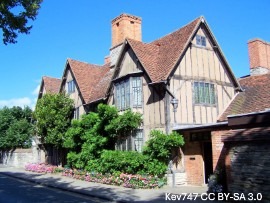
Stratford-upon-Avon home of Shakespeare's daughter is 'At Risk'
Lady Grange’s House repaired on St Kilda
.jpg)
National Trust for Scotland repairs stone cleit with link to famous island resident
Griff Rhys Jones on BBC Radio 4 Today programme
,_Green_Lane,_Derby.jpg)
The Victorian Society’s President unveiled its latest Top Ten Endangered Buildings 2026.
Need a MATE? Book your place now.

IHBC offers free webinars on applying for IHBC accreditation (Full & Associate).
UK Stained Glass Repository finds windows new homes
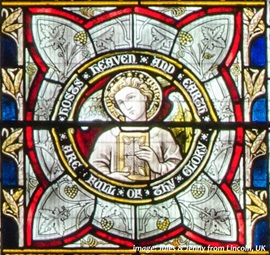
How are stained glass windows are rescued, stored and repurposed?
APPGEBE report sets high aims for quality
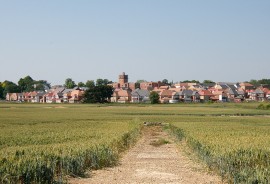
'Government must not sacrifice quality in drive to build 1.5m homes'
New measures protect Historic Shipwrecks from heritage crime

Underwater cultural heritage benefits from new HE guidance
How could the City of London skyline look in 6 years' time?

Visualisation shows approved planning applications as completed buildings
National Trust for Scotland calls for VAT cuts

Heritage neglect is encouraged by current policies
IHBC's 'Context' Issue 186 features Industrial Heritage

IHBC's members' journal reports on the challenges of conserving infrastructure
Book now for IHBC Annual School 2026

IHBC Annual School is taking place 18-20 June 2026 in Newcastle
RICHeS Research Infrastructure offers ‘Full Access Fund Call’
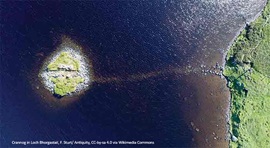
RICHeS offers a ‘Help’ webinar on 11 March
Latest IHBC Issue of Context features Roofing
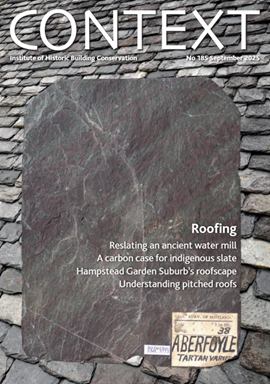
Articles range from slate to pitched roofs, and carbon impact to solar generation to roofscapes
Three reasons not to demolish Edinburgh’s Argyle House

Should 'Edinburgh's ugliest building' be saved?
IHBC’s 2025 Parliamentary Briefing...from Crafts in Crisis to Rubbish Retrofit
IHBC launches research-led ‘5 Commitments to Help Heritage Skills in Conservation’
How RDSAP 10.2 impacts EPC assessments in traditional buildings

Energy performance certificates (EPCs) tell us how energy efficient our buildings are, but the way these certificates are generated has changed.